Pubblicità


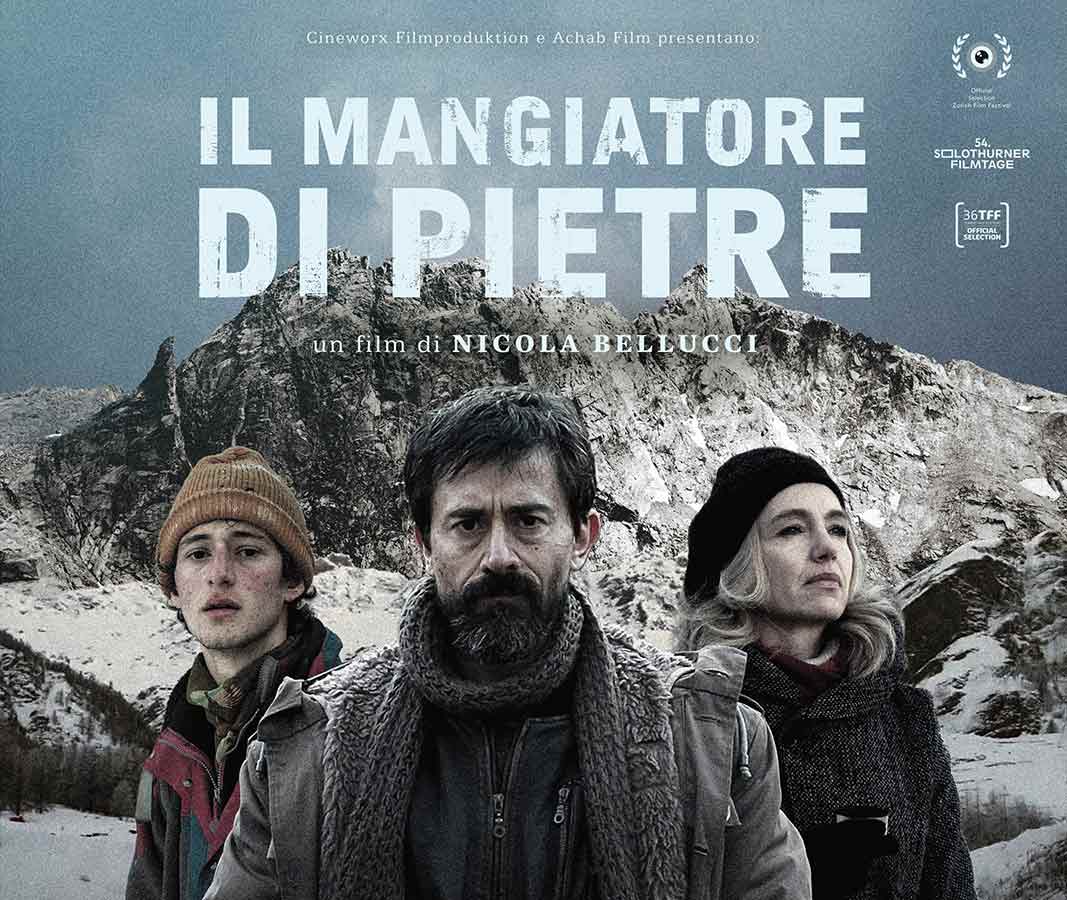


A murder is committed in a remote Alpine village; the body is found by Cesare, a former smuggler who recognises in it his own godson. The past of Cesare himself and of the characters who orbit him is called into question by the police investigations, laying bare disturbing and unhappy realities that seem to offer various solutions to the search for the killer. With a surprising ending. Tuttoitalia met the director Nicola Bellucci.
A calm tone that little resembles the common image one has of directors leading a crew; an introverted character who little by little opens up in revealing the construction of his film: this is Nicola Bellucci, director of “Il mangiatore di pietre” (The Stone Eater), and this is what he told us.
Nicola, you come from the world of documentaries; how was the approach to producing a feature film? “I come from a different world. Making documentaries means seeing foreign landscapes in which you are the one who has to ask permission to enter. The director who creates a film, on the other hand, has the need to let others into his egocentric universe. Let’s say that this approach of mine gave me the humility to take on a new experience.”
Your film initially has a gloomy, icy atmosphere, almost like a Norwegian thriller that little recalls the Italian style. You managed to convey the cold that is felt in the first scenes... “Deliberately. That is a compliment that pleases me! It is not a typically Italian film. We focused a lot on the cinematography and on the ‘polar’ atmosphere that already exists in the novel. Certainly my experience as a documentary maker helped me; the cold is essential, the characters are almost frozen, almost mute. We really did shoot in crazy weather conditions: the Varaita valley, cold, closed and archaic, lent itself very well also to conveying the atmosphere.”

Why did you choose to use dialect as the language in some passages? “In reality we made use of the physical presence of the locals, not professional actors, to give even more credibility to the characters who form the background of the story. The elderly speak Occitan and were perfect for some roles, and had incredible faces that pierced the screen.”
Speaking of faces, we can mention the protagonist, the very talented Luigi Lo Cascio. This time in a role very different from films like “I cento passi” (The Hundred Steps) or “La meglio gioventù” (The Best of Youth), right? “It was a very happy choice; he is one of the best Italian actors, who knows how to use his physicality very well, which was necessary to portray Cesare, the very introverted protagonist of few words. Luigi was doubtful at first because, for him, it was a challenge to play not the usual role of the left-wing intellectual or the Sicilian and to transform himself into a mountain dweller of the Alps. It was certainly a stimulating character, because I was looking for an actor who could express himself almost without speaking, and he managed it.”
Let’s talk about the content: in this film many topical themes are touched on, from drug trafficking to smuggling, to the few values of adolescents, from parental issues to that of immigrants. “It was all present in Davide Longo’s novel, and these arguments intrigued me a lot. I liked the protagonist and I recognised myself in some aspects of his character. In the film the topics are many, but it is not a film about migrants nor about drug trafficking. In the end one senses, after a first reading, that the theme I care about most is that of the ‘missing’ parental figure, played by various characters, not only by Cesare. There are many meaningful symbols; for example, at the beginning Cesare carves a Saint Joseph out of wood, as if it were a wish, even an unconscious one. I purposely created an unspecified place with slow timeframes, in which there must be the right timing to understand the story. Certainly against the trend of the hit-and-run of today’s cinematic offerings. I like it when films leave the doubts.”
Would you comment for us on the line in the film “wanting to know is a stupid thing, especially if it is doubt that keeps us alive”? “Of course. It is a line that I feel very much my own; it is a cornerstone of the film. It is only doubt that gives the hope of change, isn’t it?”
Where and when to go to the cinema (Basel - Bern - Flims - Zurich)
Find out where and when the film will be screened