Pubblicità




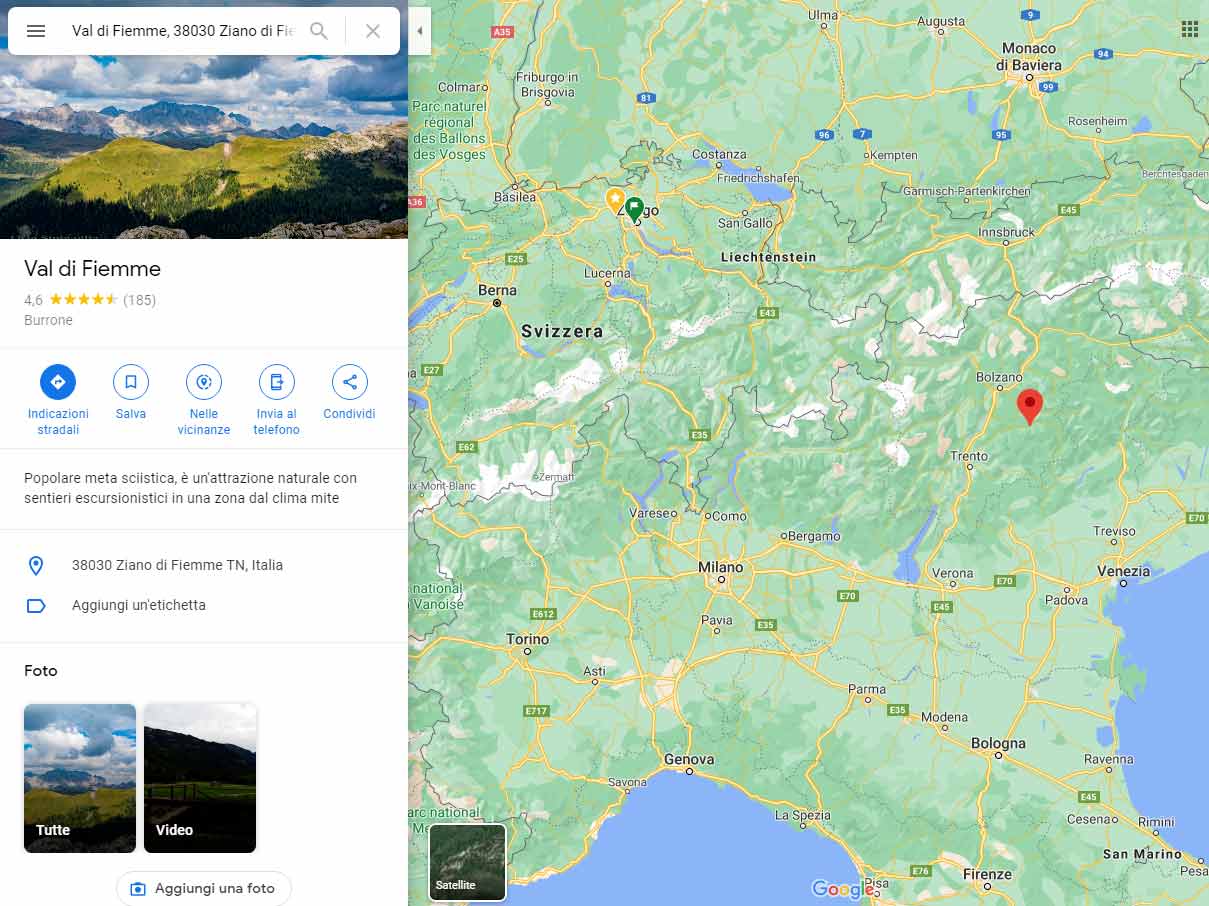
The Val di Fiemme is one of the main Dolomite valleys, set in the region of Trentino Alto-Adige. Together with the Val di Fassa and the Val di Cembra, it forms the catchment basin of the Avisio stream, a tributary of the river Adige. With its 14 municipalities, it is bounded by famous mountains such as the Catena del Lagorai and the Latemar group. It also lies between two nature parks: the one of Paneveggio Pale di San Martino and the Alto Adige one of Monte Corno. Two parks that are close by yet different in the variety of their flora and fauna. The whole Val di Fiemme can be described as a real park, thanks to the vast expanse of woodland which, tended with respect for centuries, was a source of subsistence for the local population, especially in the past. These forests have a positive influence on the quality of the air and of the climate, helped also by the orientation of the valley, which stretches mainly from west to east. The typically alpine landscape of the Val di Fiemme is shaped above all by the Norway spruce, which can grow to a height of 50 metres, with specimens reaching a circumference of up to 6 metres. The Val di Fiemme is a valley of the Dolomites, in eastern Trentino, surrounded by the Val di Fassa, the Val d’Ega and the Valsugana. The valley is made up of 11 municipalities, Predazzo, Cavalese, Tesero, Capriana, Valfloriana, Carano, Daiano, Varena, Molina di Fiemme, Panchià and Ziano, and lies enclosed between two very evocative nature parks: the Paneveggio Nature Park – Pale di San Martino and the Alto Adige one of Monte Corno. These two reserves are very different from one another, even though they are very close, and the park is known for its distinctive vegetation and for its fauna made up of many bird species.

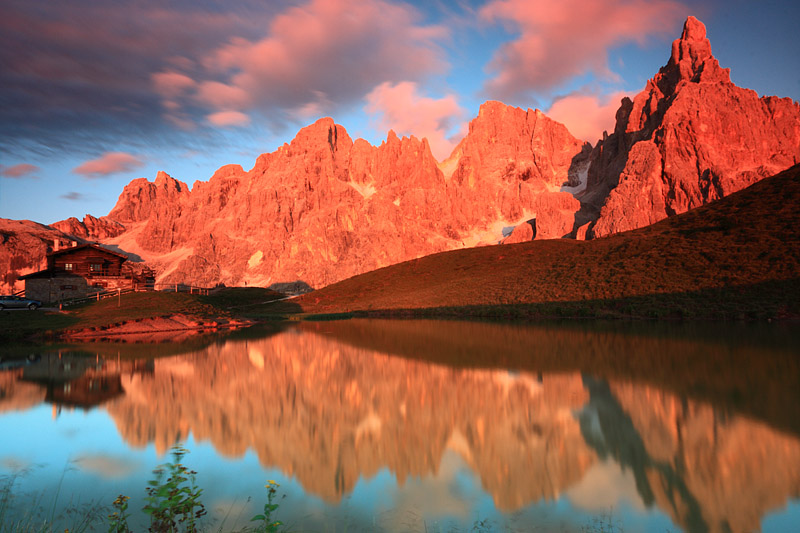
The Val di Fiemme, among the Dolomites of Trentino, is surrounded by peaks of rare beauty, such as the spires of the Latemar, the Pale di San Martino and the Corno Bianco, recognised by Unesco as “Natural World Heritage”. One of the wonders that rest on the particular mineralogical composition of the Dolomites is without doubt the phenomenon known as Enrosadira. This unique phenomenon means that most of the peaks of the Dolomites take on marvellous colours that paint a chromatic spectrum ranging from pale yellow to fiery red, then softening into delicate shades of violet, above all at dawn and at sunset, until they disappear completely into the darkness of the night. The effect is heightened by the reflectivity of the rock faces of the Dolomites, formed of dolomite rock containing dolomite, a compound of calcium carbonate and magnesium. It is particularly visible on summer evenings, when the air is clearer and the twilight lasts longer.

The Paneveggio Park and the visitor centre of the same name lie about ten kilometres from Predazzo, just before Passo Rolle still in the province of Trento. What undoubtedly leaves visitors open mouthed is the deer enclosure, a large area where a sizeable herd of these animals lives in semi freedom. Thanks to the observation points and the walk around the fenced area it is in fact not difficult to spot them, and with a little luck you can admire them from close up and watch their behaviour in the middle of nature. The oasis of the ungulates is surrounded by a walkway and protected by a fence that allows them to be photographed at close range. The deer live in the park among the Foreste dei Violini (forests of the violins) of the Val di Fiemme, where the resonance spruces grow. The wood of these spruces was once loved by the famous 17th century violin maker Stradivari and is still prized today by violin makers all over the world. Here you can admire the transparent bridge of the Marciò path, two rope bridges over the stream
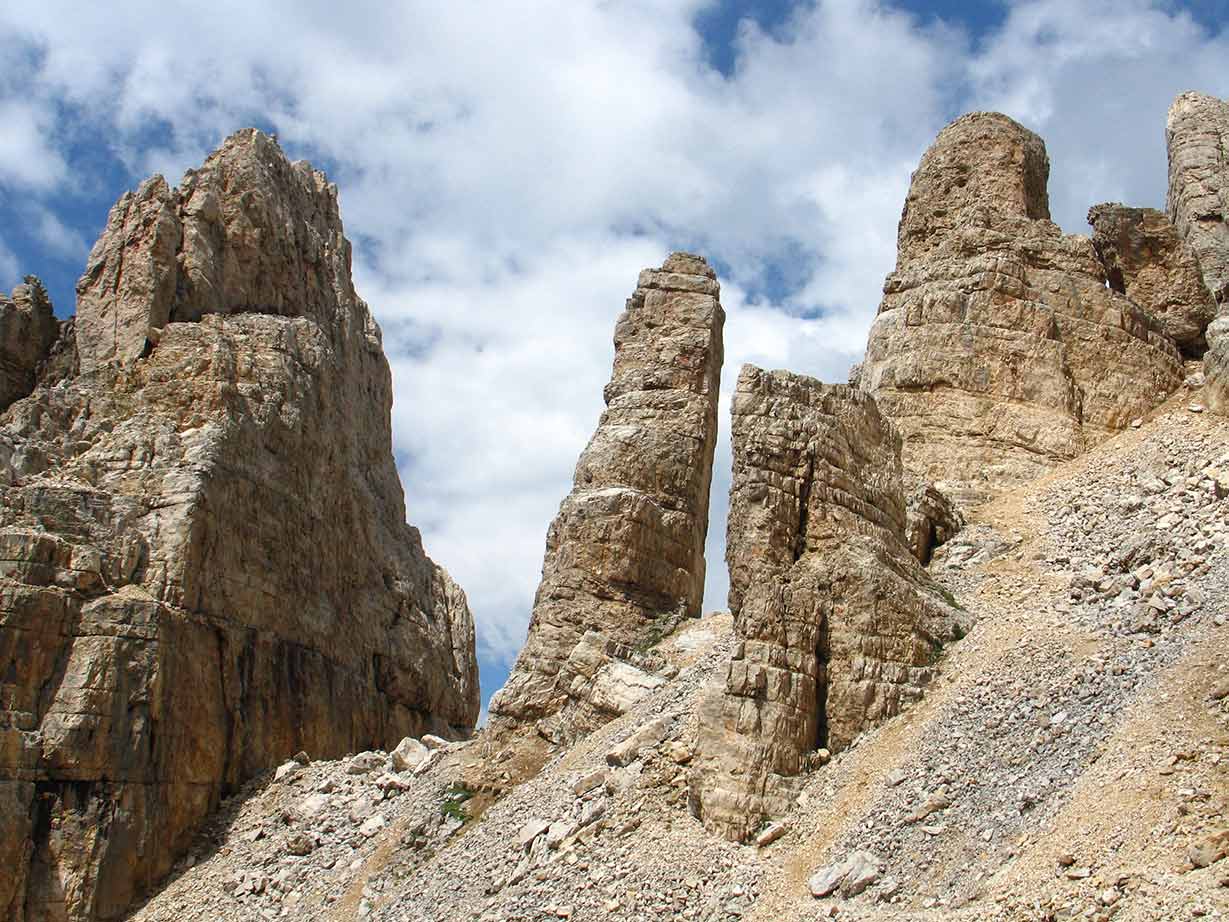
The Latemar is a Dolomite mountain group that stretches between the provinces of Trento and Bolzano, where the ridge of the peaks acts as the border between the two provinces. The so called “Torre di Pisa” is a 40 metre high spire of dolomite rock that strongly recalls the tower of the Tuscan city of the same name because of its striking lean.From the “Torre di Pisa” mountain hut you carry on walking, still on path no. 516, towards the Forcella dei Camosci. You climb a few metres behind the hut and, from the helicopter landing pad, you get an even wider view over the surrounding peaks, where to the west you can admire the famous “Tower”. Once past the short stony stretch of the descent from the “Tower”, you carry on down for another short steep stretch, then level ground, as far as the fork for the Forcella dei Camosci. This part is very distinctive: on the left there is a rock wall where chamois quite often appear; on the right you can see a stony expanse with a few patches of grass. In the direction of our route, in the background, you can see the Forcella dei Campanili and further to the right the Schenon del Latemar, that is the Dolomite peak known to hikers with proven skill. The via ferrata of the Campanili del Latemar passes through the spires on the summit part of the Schenon and the view you take in from up there is incredible. You reach this 40 metre high natural monument by going up from Predazzo, with the gondola lift to Gardoné and then with the chairlift up to Passo Feudo. From here you continue on a rather steep path that gives great satisfaction. Along the route you come across curious “stone men”, cairn waymarks created by hikers to signal the route in case of fog.
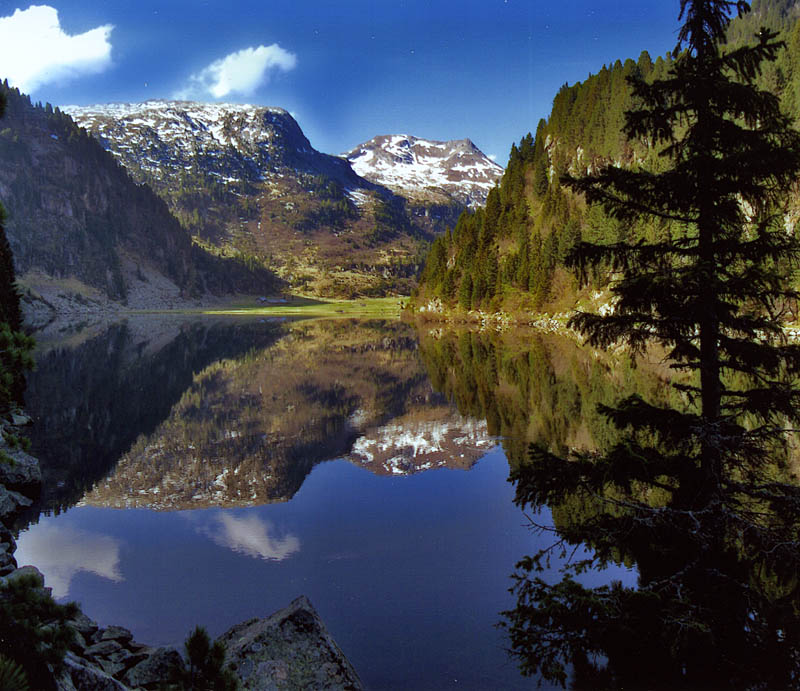
The sequence of peaks of the Catena del Lagorai runs for 70 kilometres. A long stretch towers over the Val di Fiemme and seems to draw in the sky the outlines of gigantic waves that ripple and slide. The unspoilt Catena del Lagorai is something of an alter ego of the Dolomites. The Lagorai group is bounded to the north by the Val di Fiemme and the Travignolo, to the east by the Val Cismon, by the Valsugana to the south, and by the Val di Cembra and the Pinè plateau to the west and south west. The abundance of water shapes the hydrography of the whole group, which is dotted with a high number of lakes of different sizes and shapes, from which several streams flow down to feed the rivers Adige, Avisio and Brenta; the Vanoi and Senaiga streams join the river Cismon. The largest lake is the one of Calaita, the best known are perhaps those of Colbricon. If the limestone dolomite rocks do not hold a drop of water but enchant with reddish reflections, the porphyry rocks of the Lagorai are precious caskets of emerald green water. Some lakes are surrounded by rhododendrons, others by meadows, others again are set into the rock. On the Lagorai, where the eagles dare, you can walk for days without meeting a human being. It is one of the last alpine territories to have remained intact. There are 14 stretches of water of the Lagorai that overlook the Val di Fiemme. Some are easy to reach, others require well trained legs.

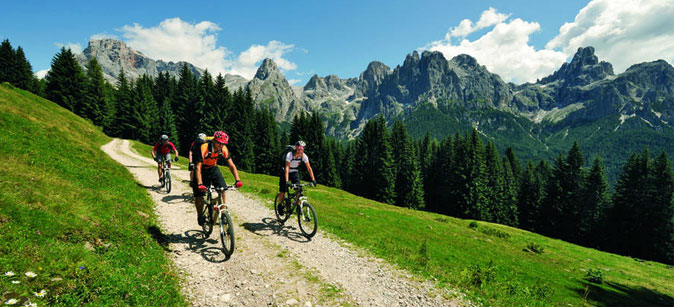
8 km from Varena, opening onto enchanting Dolomite views, lies the Altopiano di Lavazé: one of the most fascinating settings of the Val di Fiemme. The Passo di Lavazè offers a strongly unspoilt natural environment, at 1,808 metres straddling the provinces of Trento and Bolzano, and has been known and appreciated since the 1950s for its renowned cross country skiing centre, whose trails wind in the sun or through the beautiful woods of Norway spruce, silver fir and Swiss pine, with views of the Latemar, the Catinaccio and the valleys of the Alto Adige Alps. The artificial snowmaking system over 6 km guarantees that it opens even when snow is scarce. The immense expanse of meadows, framed by spruces, larches and Swiss pines, is dominated by the Pala di Santa (2,488 m). From the plateau you enjoy a wide view over the Catinaccio and the Latemar. The Passo Lavazè lies on a plateau 1,805 metres above sea level; in summer it is the starting point of countless excursions and paths, while in winter, thanks to its morphology, it is ideal for cross country skiing. At an altitude of 1,805 metres a stage opens up to be crossed on foot or by mountain bike, between tastings in the mountain huts. Flower lovers discover a wonderful garden of biodiversity on the Altopiano di Lavazé.
Two small bridges offer two thrilling viewpoints. The one at the foot of the waterfall gives back all the energy of a powerful rush of water which, turning to spray, comes close to brushing the face of the onlooker. The little bridge above the waterfall lets you feel the exhilaration of a liquid leap into the void. A walk in the woods among monumental spruces, a lively brook, stones painted by mosses and lichens and an observation point over the falling water. The waterfall of Cavalese is one of the things absolutely to be seen in the Val di Fiemme. Getting there is very easy. Along the provincial road, after Molina di Fiemme, coming from the Val di Cembra, you follow the sign for the waterfall and cross a small bridge where, a little further on, there is a small car park. The waterfall of Cavalese is right there in front of our eyes: a beautiful drop of 15 metres but very powerful. You can admire it from below or from a comfortable path that climbs into the wood and reaches, in about 10 minutes, a small belvedere terrace in close contact with the highest part of the waterfall. The Cascata-Tabià-Cascata path promises total immersion in nature, avoiding walking along the forest road open to traffic. It is advisable to walk it anticlockwise. From the waterfall of Cavalese you cross the road bridge that leads into the Val Moena and turn immediately left, where a path crosses a long stretch of wood, skirts a pasture and leads to the Pezo del Gazolin, an imposing monumental Norway spruce. Leaving the little road, the path climbs up from the Rio di Val Moena, between enchanting glimpses, to reach the Ponte del Tabià, at the start of the pasture of the same name. Here the path begins to descend in hairpins beside the waterfall, as far as a panoramic point from which you can watch the falling water from close up.
The Magnifica Comunità di Fiemme boasts a thousand year history with roots far back in time, and its existence was officially established for the first time in the Patti Gebardini, a document dated 1111 AD. It is a public body of historical origin, set up to protect the community of the people of Fiemme and to enhance their environmental and cultural heritage. Guardian of ancient laws and traditions, it still administers today a considerable collective property of 20,000 hectares of land made up of mountains, pastures and forests. About 11,000 hectares are covered by woods that the Comunità manages, planning timber cutting and reforestation and looking after the forest roads. The famous Norway spruce predominates in the forests. The Magnifica Comunità di Fiemme has its seat in Cavalese. The imposing Renaissance palace in the centre of Cavalese is its official seat and is a leading hub for the historical and artistic cultural life of the valley. It houses an important art gallery and an archive of manuscripts, statutes and writings that preserve the ancient history of Fiemme. Complex restoration works have been carried out on the palace over the years, giving back the ancient splendour it deserves. Discreet lighting gives the museum and its art gallery an atmosphere steeped in mystery, casting here and there surprising geometries of light that bring out the beauty of the paintings and frescoes and also of the 150 masterpieces of the Fiemme school of painting visible on the walls of the palace.